US Queer History Timeline

hearts

Click through the tabs on the sidebar to see different moments in US queer history!


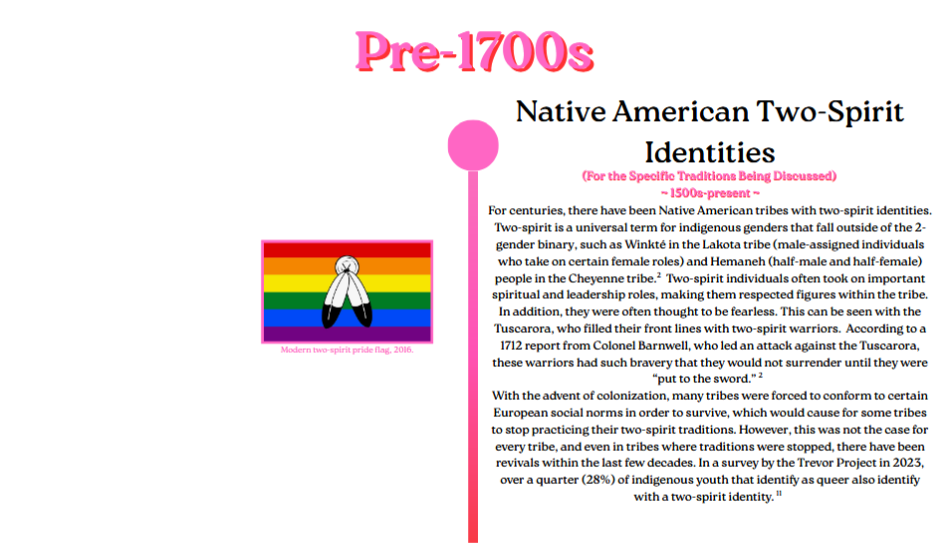
Native American Two-Spirit Identities: For centuries, there have been Native American tribes with two-spirit identities. Two-spirit is a universal term for indigenous genders that fall outside of the 2-gender binary, such as Winkté in the Lakota tribe (male-assigned individuals who take on certain female roles) and Hemaneh (half-male and half-female) people in the Cheyenne tribe. Two-spirit individuals often took on important spiritual and leadership roles, making them respected figures within the tribe. In addition, they were often thought to be fearless. This can be seen with the Tuscarora, who filled their front lines with two-spirit warriors. According to a 1712 report from Colonel Barnwell, who led an attack against the Tuscarora, these warriors had such bravery that they would not surrender until they were “put to the sword.”^2
With the advent of colonization, many tribes were forced to conform to certain
European social norms in order to survive, which would cause for some tribes
to stop practicing their two-spirit traditions. However, this was not the case for every tribe, and even in tribes where traditions were stopped, there have been
revivals within the last few decades. In a survey by the Trevor Project in 2023,
over a quarter (28%) of indigenous youth that identify as queer also identify
with a two-spirit identity.^9

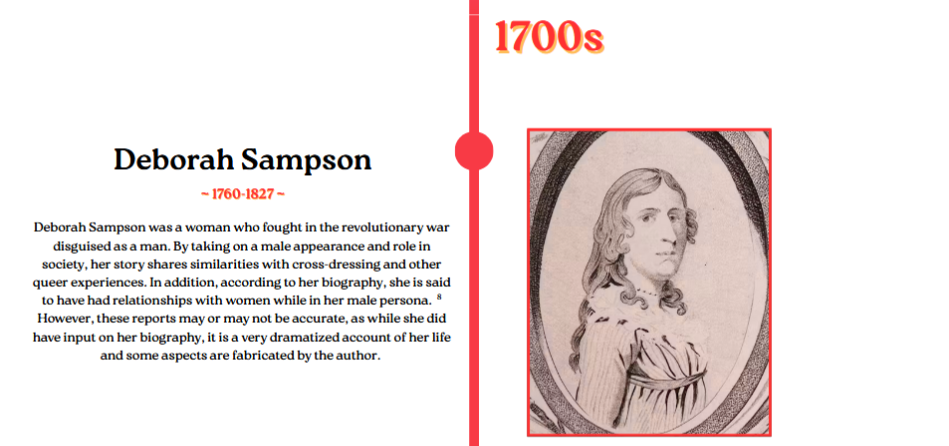
Deborah Sampson: Deborah Sampson was a woman who fought in the revolutionary war
disguised as a man. By taking on a male appearance and role in
society, her story shares similarities with cross-dressing and other
queer experiences. In addition, according to her biography, she is said
to have had relationships with women while in her male persona.
However, these reports may or may not be accurate, as while she did
have input on her biography, it is a very dramatized account of her life
and some aspects are fabricated by the author.

George Snodgrass was assigned female at birth and, at 17 years old,
moved to Boston with a new male name and appearance. George’s
identity was later discovered and he was arrested on several occasions,
yet he always went back to his preferred gender presentation
immediately on the advent of release. This determination is part of
what sensationalized his story in NY newspapers, as journalists and
city officials alike were “puzzled” as to why he refused to return to a
female gender presentation regardless of the number of arrests.

George and Elisabeth Wilson were Scottish immigrants who
lived in New York City. In 1836, George was arrested for public
intoxication and the officer handling him grew suspicious of
his gender, resulting in both him and his wife being questioned
by the police. George was assigned female at birth but lived as
a man, reportedly in order to find work. He told the police that
his wife did not know his assigned sex when they began dating,
but the discovery did not negatively affect their relationship.
The article written about Wilson’s story is considered the first
use of the term 'female husband,' or female assigned person
who presents as a man and has a wife, in the USA.
6
6 Osh-Tisch, which translates to “finds them and kills them,was a Crow badé (Two-Spirit) who is celebrated for their
bravery in the Battle of Rosebud against the Lakota

Because of racism within New York City law enforcement, Harlem was
not considered worth policing to same degree that they policed white
areas. This allowed for gay nightclubs to be run fairly openly, and
Harlem became a center of queer culture.Among the residents of 1920s Harlem was actress Ethel Walters and
her girlfriend Ethel Williams. Walters had a very successful acting
career, and became the first African American to star in a television
show and the first African American to be nominated for a Primetime
Emmy.

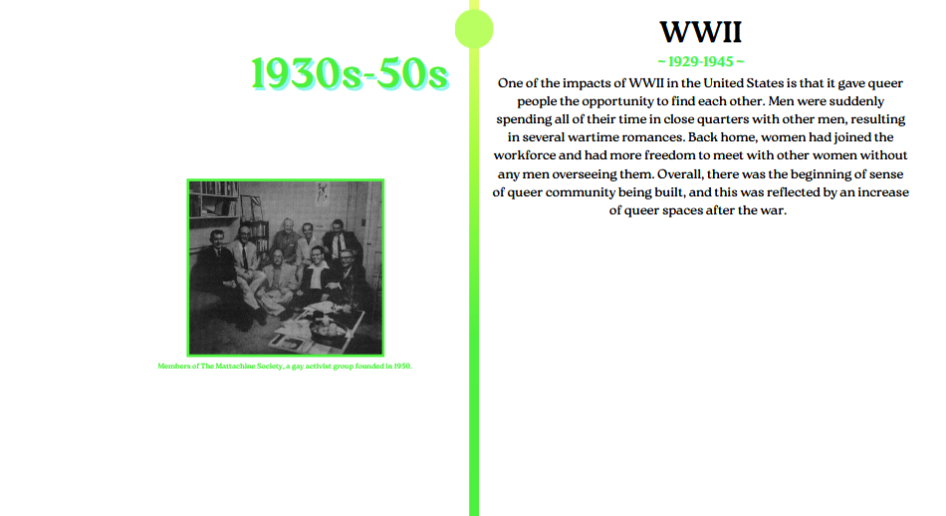
One of the impacts of WWII in the United States is that it gave queer
people the opportunity to find each other. Men were suddenly
spending all of their time in close quarters with other men, resulting
in several wartime romances. Back home, women had joined the
workforce and had more freedom to meet with other women without
any men overseeing them. Overall, there was the beginning of sense
of queer community being built, and this was reflected by an increase
of queer spaces after the war.

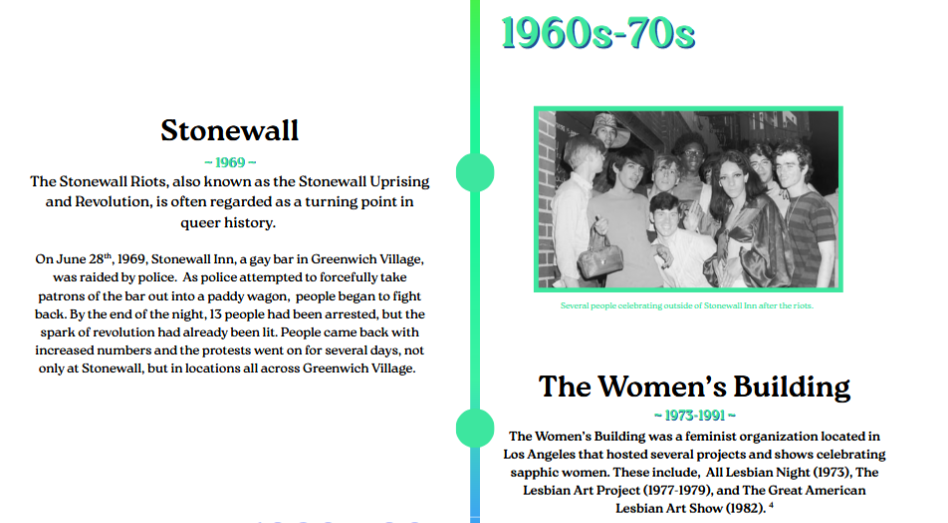
The Stonewall Riots, also known as the Stonewall Uprising
and Revolution, is often regarded as a turning point in
queer history. he Women’s Building was a feminist organization located in
Los Angeles that hosted several projects and shows celebrating
sapphic women. These include, All Lesbian Night (1973), The
Lesbian Art Project (1977-1979), and The Great American
Lesbian Art Show (1982).

The first reported case of HIV/AIDS was on June 5th, 1981. It was
believed to only affect gay men, and while this is not actually true,
this reputation is undoubtedly the reason it was largely ignored
by the government. Reagan, who had been president since before
the start of the crisis, did not publicly address the issue until April
1 , 1986. By this point, about 21,000 Americans had died from the
disease.

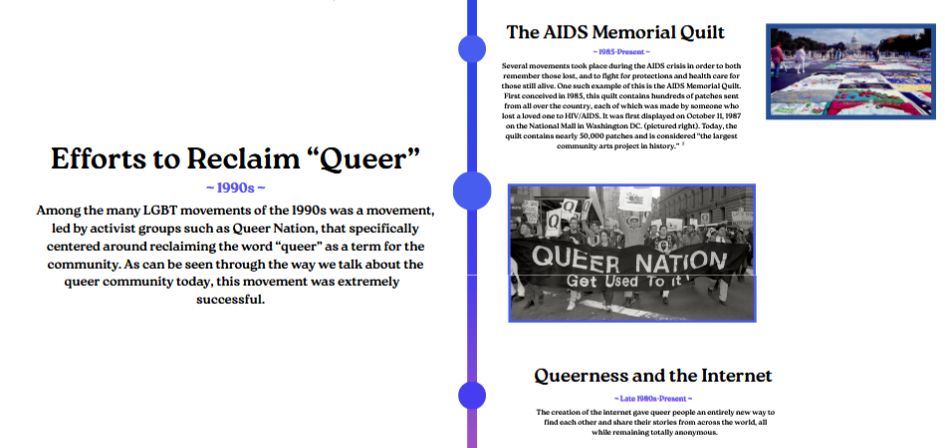
Several movements took place during the AIDS crisis in order to both
remember those lost, and to fight for protections and health care for
those still alive. One such example of this is the AIDS Memorial Quilt.
First conceived in 1985, this quilt contains hundreds of patches sent
from all over the country, each of which was made by someone who
lost a loved one to HIV/AIDS. It was first displayed on October 11, 1987
on the National Mall in Washington DC. (pictured right). Today, the
quilt contains nearly 50,000 patches and is considered 'the largest
community arts project in history.

On June 26 , 2015, same-sex marriage was legalized across the
United States by the Supreme Court’s ruling of the case
Obergefell v. Hodges.

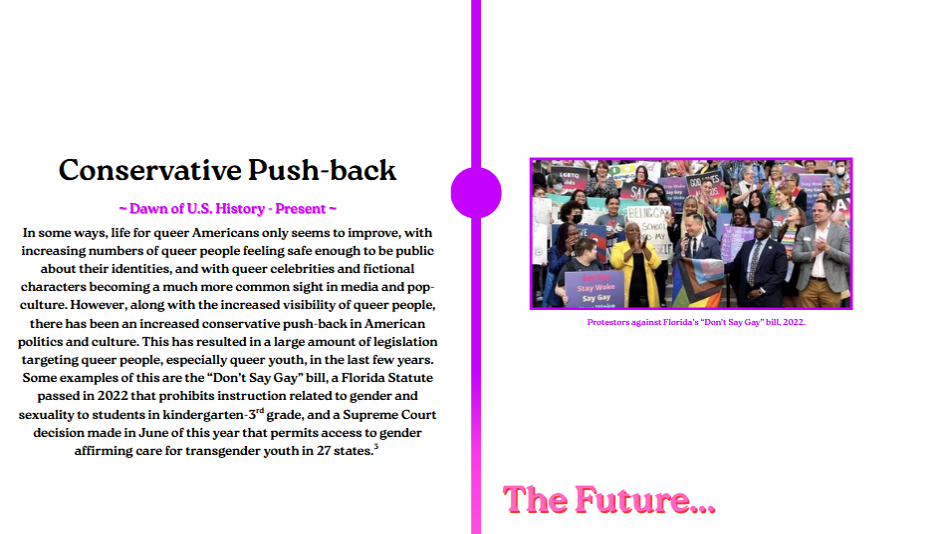
In some ways, life for queer Americans only seems to improve, with
increasing numbers of queer people feeling safe enough to be public
about their identities, and with queer celebrities and fictional
characters becoming a much more common sight in media and pop-
culture. However, along with the increased visibility of queer people,
there has been an increased conservative push-back in American
politics and culture. This has resulted in a large amount of legislation
targeting queer people, especially queer youth, in the last few years.
Some examples of this are the 'Don’t Say Gay' bill, a Florida Statute
passed in 2022 that prohibits instruction related to gender and
sexuality to students in kindergarten-3 grade, and a Supreme Court
decision made in June of this year that permits access to gender
affirming care for transgender youth in 27 states.
rd
3

Notes

frogs

This timeline was created on December 17, 2025.